Have you ever stepped off a 12-hour flight feeling like a human raisin? Your skin is parched, your legs feel heavy, and your brain is completely scrambled. It is not just your imagination. Flying at 35,000 feet does wild things to the human body.
The air inside a commercial aircreate cabin is pressurized to an equivalent altitude of 6,000 to 8,000 feet¹. This environment causes mild hypoxia, meaning you inhale less oxygen than you do at sea level¹. At the same time, the relative humidity plunges to a desert-like 10% to 20%³.
If you want to land at your destination feeling energized instead of exhausted, you need a plan. Let's walk through the exact steps you can take to keep your body and mind in peak condition during long-haul travel.
Mastering Hydration and Nutrition at 30,000 Feet
The dry air inside the cabin actively strips moisture from your body with every breath you take. To stay ahead of this invisible thief, you have to change how you drink and eat in transit.
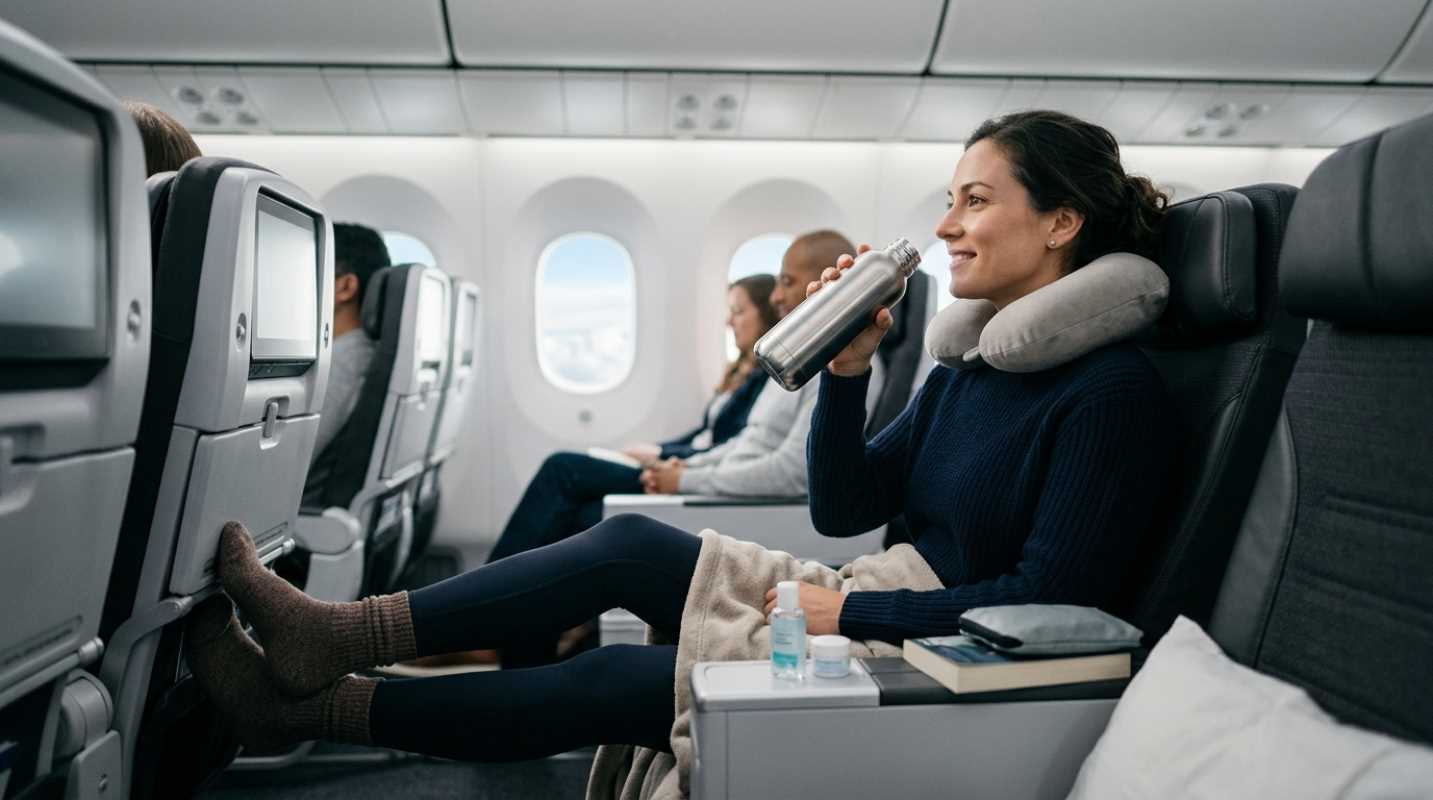
First, let's talk about the rule of eight. Dr. Shazia A. Khan from Northwestern Medicine recommends drinking eight ounces of water for every single hour you spend in the air³. It sounds like a lot, and yes, you will be visiting the tiny airplane bathroom more often. But that movement is actually a secret weapon for your circulation.
You should also skip the pre-flight coffee and the complimentary cabin alcohol. Both are strong diuretics that accelerate fluid loss. Alcohol is especially tricky at high altitudes because it impairs how your cells absorb oxygen, making the symptoms of mild hypoxia feel much worse.
Your digestive system slows down when you are flying, which is why airplane food often leaves you feeling bloated and sluggish. To prevent this, focus on light, nutrient-dense options.
• Electrolytes: Drop an electrolyte tablet into your water bottle. This helps maintain fluid balance at a cellular level and keeps that midday brain fog away.
• Light Snacks: Pack raw nuts, seeds, and fresh fruit instead of eating high-sodium airport snacks.
• The Water Bottle Rule: Bring a large, empty reusable bottle through security and fill it up before boarding so you do not have to rely on tiny plastic cups.
Movement Approaches for Deep Vein Thrombosis Prevention
Sitting still for hours is not just uncomfortable, it can also be dangerous. Venous Thromboembolism (VTE), which includes deep vein thrombosis (DVT), is a serious risk on long journeys.
Flights lasting longer than four hours increase your risk of VTE two- to four-fold, with the risk peaking on journeys over eight to ten hours². Surprisingly, where you sit matters. Sitting in a window seat carries a two-fold increase in VTE risk compared to an aisle seat because window passengers are less likely to stand up². If you have a body mass index (BMI) over 30 and sit by the window, that risk increases six-fold².
The current 2026 guidelines from major hematology organizations emphasize that routine medical prevention is not necessary for healthy, low-risk travelers⁴,⁵. You do not need compression socks or aspirin if you have no pre-existing conditions⁴,⁵.
But if you are in a high-risk category, such as having a history of blood clots, recent surgery, pregnancy, active cancer, or being over age 70, you should wear properly fitted, below-the-knee graduated compression stockings providing 15 to 30 mmHg of pressure⁴.
To keep your blood flowing, practice these simple in-seat exercises every hour
• Calf Pumps: Keep your heels on the floor and lift your toes high, then keep your toes down and lift your heels. Repeat this 20 times to activate the calf muscle pump.
• Ankle Circles: Lift your feet slightly and draw circles with your toes, doing 10 clockwise and 10 counterclockwise.
• Knee Lifts: Hug each knee to your chest for 15 seconds to release tension in your lower back.
• Aisle Walks: Stand up and walk the aisle for five minutes every two hours. Booking an aisle seat makes this much easier.
Optimizing In-Flight Wellness for Better Sleep
Getting quality sleep on a plane is the holy grail of long-haul travel. It is difficult, but not impossible if you set the right environment.
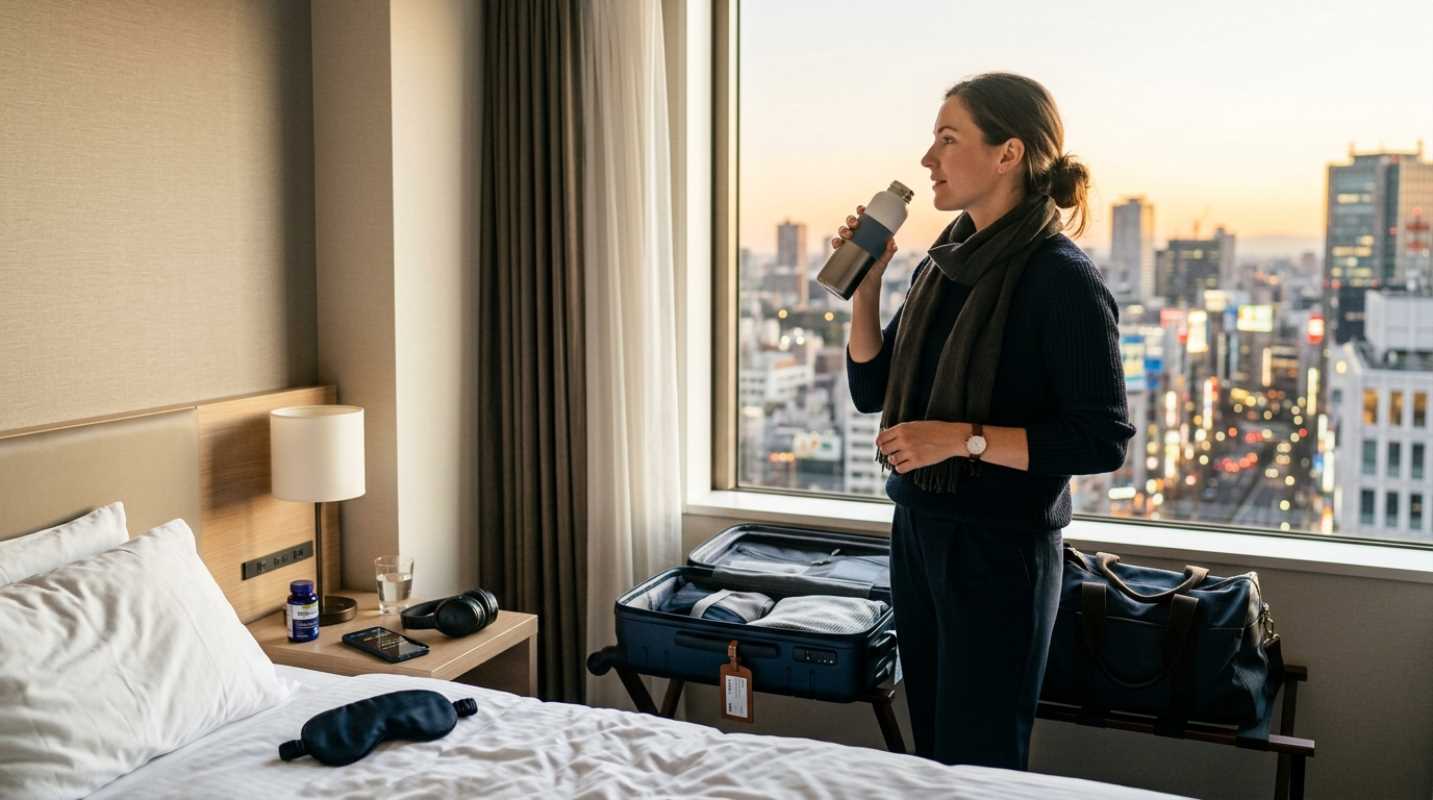
Think of your seat as a personal sanctuary. You need to block out the sensory chaos of the cabin. A high-quality eye mask and active noise-canceling headphones are non-negotiable tools for this job.
To manage jet lag, you must control your light exposure. Light is the primary cue that tells your internal biological clock what time it is. If you are traveling east, avoid bright morning light and seek out afternoon sun. If you are traveling west, do the opposite and seek late afternoon light to delay your sleep cycle.
You can also use a low-dose melatonin supplement (around 0.5 mg to 3 mg) at the local bedtime of your destination to help your body adapt.
• Pre-Travel Shifting: Start adjusting your sleep schedule by 30 to 60 minutes each day for three days before you leave.
• The Gut-Clock Reset: Change your eating schedule to your destination's time zone as soon as you step on the plane.
• Pre-Sleep Routine: Clean your face, brush your teeth, and put on comfortable clothes to signal to your brain that it is time to rest.
Hygiene and Immune Support in Confined Spaces
We have all heard the cabin cough. Although modern planes have excellent air filtration systems, the physical surfaces around you are a different story.
When you first sit down, sanitize your immediate space. Use disinfecting wipes on the tray table, the armrests, the seatbelt buckle, and the entertainment screen.
Your body's first line of defense is your mucosal barrier. The dry cabin air dries out your nasal passages, making them more vulnerable to viruses³.
• Nasal Hydration: Use a simple saline nasal spray every few hours to keep your nasal passages moist and functioning.
• Eye Care: Apply preservative-free lubricating eye drops to prevent dry, irritated eyes.
• Air Vents: Open your overhead air vent and point it straight down in front of your face. This creates a gentle barrier of clean, filtered air that helps push away stagnant air.
• Masking: Wearing a high-quality mask like an N95 or KN95 protects you from airborne germs but also traps humidity from your breath, keeping your airways moist.
The Mental Game Managing Stress and Arrival Readiness
Long transit days can be incredibly stressful, and high stress levels produce cortisol, which weakens your immune system and disrupts sleep.
The moment you board the plane, change your watch to the destination time zone. This is a simple psychological trick that helps you stop thinking about what time it is back home and starts preparing your brain for your new reality.
If you feel travel anxiety creeping in, practice box breathing. Inhale for four seconds, hold for four seconds, exhale for four seconds, and hold again for four seconds. It is a rapid way to calm your nervous system.
When you finally land, resist the urge to immediately crash in your hotel room. Get outside, walk around in the natural sunlight, and eat a meal at the local dinner time. By managing your hydration, movement, sleep, and mental state, you will step off the jet bridge ready to take on whatever adventure awaits you.
Sources:
1. CDC Air Travel Guidelines
https://www.cdc.gov/yellow-book/hcp/travel-air-sea/air-travel.html
2. CDC Deep Vein Thrombosis and Pulmonary Embolism Guidelines
https://www.cdc.gov/yellow-book/hcp/travel-air-sea/deep-vein-thrombosis-and-pulmonary-embolism.html
3. Northwestern Medicine Flight Travel Tips
https://www.nm.org/healthbeat/healthy-tips/tips-for-plane-travel
4. Thrombosis Canada Clinical Guides
https://thrombosiscanada.ca/hcp/practice/clinical_guides?language=en-ca&guideID=91
5. Dr. Oracle DVT Prophylaxis Article
https://www.droracle.ai/articles/1217830/is-prophylaxis-for-deepvein-thrombosis-dvt-useful-during-longhaul
*This article on Tikritics is for informational and educational purposes only. Readers are encouraged to consult qualified professionals and verify details with official sources before making decisions. This content does not constitute professional advice.*