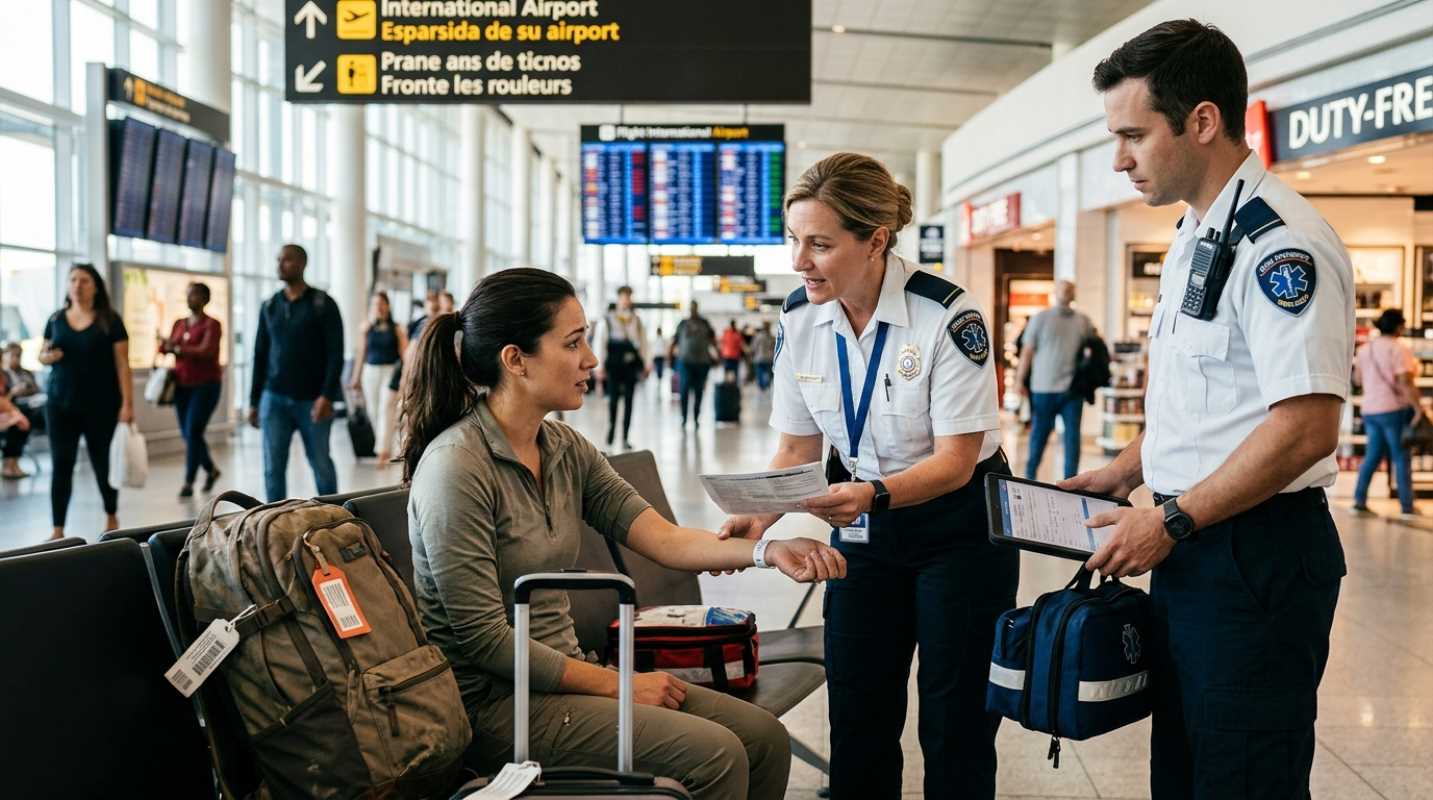
Imagine you are wandering through a bustling night market in Tokyo, enjoying the sights, when suddenly a sharp, blinding pain hits your lower back. Or maybe you are hiking in the Swiss Alps, lose your footing, and hear a sickening crack in your ankle.
It is the phone call no traveler wants to make, yet about 15% of us will face some kind of medical issue while away from home.¹ For business travelers, the odds are even higher, with over half experiencing some kind of incident abroad.
So what does this actually mean for your next trip? It means you cannot treat health preparation as an afterthought.
Preparation - The Best Defense is a Good Plan
First, let us talk about travel health insurance. It is absolutely non-negotiable. Standard domestic health insurance, including Medicare, usually stops working the second you cross the border.²
With global medical cost inflation hitting double digits recently, a single night in a foreign hospital can easily wipe out your savings. Travelers are finally waking up to this reality, with insurance attachment rates climbing past 80% as people realize health coverage is a necessity, not a luxury.³
Before you pack your bags, you need to curate a medical go-bag. Do not just throw some aspirin in your suitcase. You need a dedicated pouch containing
• Prescriptions: Keep them in their original pharmacy bottles to avoid issues with local customs.
• Generic names: Write down the generic names of your medications, because brand names vary wildly around the world.
• Medical history: A brief, printed summary of your allergies, blood type, and chronic conditions.
• Emergency contacts: Written contact info for your primary care doctor and your insurance provider.
Also, take five minutes to research your destination before you land. Do not assume 911 works everywhere. It is 112 in the European Union and 999 in the UK. Write down the local emergency number and the name of the nearest reputable hospital.
Immediate Steps When a Crisis Strikes
When a crisis actually strikes, panic is your worst enemy. Take a deep breath and assess the situation. Is it life-threatening? If you are dealing with chest pain, severe bleeding, or unconsciousness, do not overthink it. Call the local emergency services immediately or get to the nearest emergency room.
But what if it is a non-emergency, like a deep cut or a persistent fever? In those cases, do not just walk into the first clinic you see. Call your travel insurance provider's 24-hour assistance hotline first. They can direct you to vetted clinics where you will get proper care without being overcharged.
If you are facing a language barrier, communication can feel terrifying. How do you explain a food allergy or a specific type of pain when you do not speak the language?
• Use translation apps: Google Translate has a conversation mode that works surprisingly well in real-time.
• Keep it simple: Speak in short, direct sentences. Avoid idioms or medical jargon.
• Show, don't just tell: Point to where it hurts and use gestures to explain how an injury happened.
Throughout the entire ordeal, you must document everything. It is tedious, but it is your golden ticket to getting reimbursed later. Ask for a copy of every medical report, write down the names of the doctors you speak with, and keep every single receipt. Even a taxi ride to the hospital can sometimes be claimed, so save those slips of paper.
Understanding the Overseas Hospital System
Walking into a foreign hospital can feel like stepping onto another planet. The rules are different, the administrative hurdles can be baffling, and the environment can feel entirely unfamiliar.
How do you know if the hospital you are in is actually safe and reputable? If you did not get a recommendation from your insurance provider, look for facilities accredited by Joint Commission International (JCI). This is the gold standard for global healthcare.
You also need to understand your rights as a foreign patient. This is where your home country's embassy comes into play. If you are in a bind, call them.
But let us be realistic about what they can actually do
• What the embassy can do: They can provide lists of English-speaking doctors, notify your family back home, and help coordinate emergency money transfers.
• What the embassy cannot do: They will not pay your medical bills, they cannot get you out of legal trouble, and they cannot dictate your medical treatment.
The biggest shock for most travelers is how overseas hospitals handle money. Many foreign facilities, even in highly developed countries, will not treat you (unless it is an immediate life-or-death situation) without a cash deposit or proof of insurance.
Do not wait until discharge to sort this out. The second you are admitted, present your travel insurance card. Ask the billing department to contact your insurer immediately to set up direct billing. This make sures the hospital bills the insurance company directly, saving you from having to pay thousands of dollars out of pocket.
The Role of Travel Health Insurance in Your Recovery
Let us talk about how your insurance policy actually works when things get serious. If a doctor recommends a major procedure, like surgery, your first call must be to your insurance provider.
Why? Because authorizing a major medical procedure without their green light can result in your claim being denied. Your insurer's medical team will want to review the diagnosis to make sure the treatment is necessary and up to international standards.
Then there is the issue of medical evacuation. If you are in a remote area or a country with substandard medical facilities, you may need to be moved.
A medical evacuation is not a simple helicopter ride. It is an incredibly complex, fully staffed flying intensive care unit.
Because of this, the costs are astronomical. A medevac from Europe to the U.S. can easily run between $50,000 and $125,000, while a flight from the Asia-Pacific region can top $250,000.⁵ If you do not have adequate evacuation coverage (experts recommend looking for a policy with at least $100,000 to $500,000 in emergency medical coverage), you will be on the hook for those costs.⁴
To make sure your post-trip reimbursement goes smoothly, keep your paperwork organized. Before you leave the hospital, make sure you have
1. An itemized bill showing every single charge.
2. A medical report with your official diagnosis.
3. Receipts for every payment you made out of pocket.
4. Copies of any diagnostic results, like X-rays or blood tests.
If you are planning your next adventure, here are some of the most reliable travel insurance providers to consider
Post-Emergency Steps to Get Back on Track
Once the worst is over, you might be tempted to jump right back into your itinerary. But hold on a second. Is it actually safe for you to fly?
Changes in cabin pressure can be dangerous after certain medical conditions, like surgeries, collapsed lungs, or even severe ear infections. Get a written "fit to fly" clearance from the attending doctor before you book your ticket home.
When you finally get back to your home country, do not just shrug off the incident. Schedule a follow-up appointment with your primary care physician. Bring all your foreign medical records and translation printouts with you so they can update your medical file and make sure your recovery is on track.
Finally, take some time to reflect on what happened. What worked well? What was a nightmare to handle?
Use this experience to fine-tune your safety protocols for future trips. Maybe you need to upgrade your insurance coverage next time, or perhaps you will pack a more complete first-aid kit. Traveling is about adventure, but returning home safe and sound is the ultimate goal.
Sources:
1. MoneyGeek - Emergency Medical Claims
https://www.moneygeek.com/insurance/travel/emergency-medical-claims-top-risk/
2. U.S. State Department - Insurance Abroad
https://travel.state.gov/en/international-travel/planning/guidance/insurance.html
3. Battleface - Travel Insurance Trends
https://www.battleface.com/en-us/partner-insights/2025-us-travel-insurance-trends-analysis/
4. Squaremouth - Medical Travel Insurance
https://www.squaremouth.com/plans/medical
5. Jet Set Protect - Medical Evacuation Costs
https://www.jetsetprotect.com/guides/scenario/medical-evacuation-costs?utm_source=chatgpt.com
*This article on Tikritics is for informational and educational purposes only. Readers are encouraged to consult qualified professionals and verify details with official sources before making decisions. This content does not constitute professional advice.*