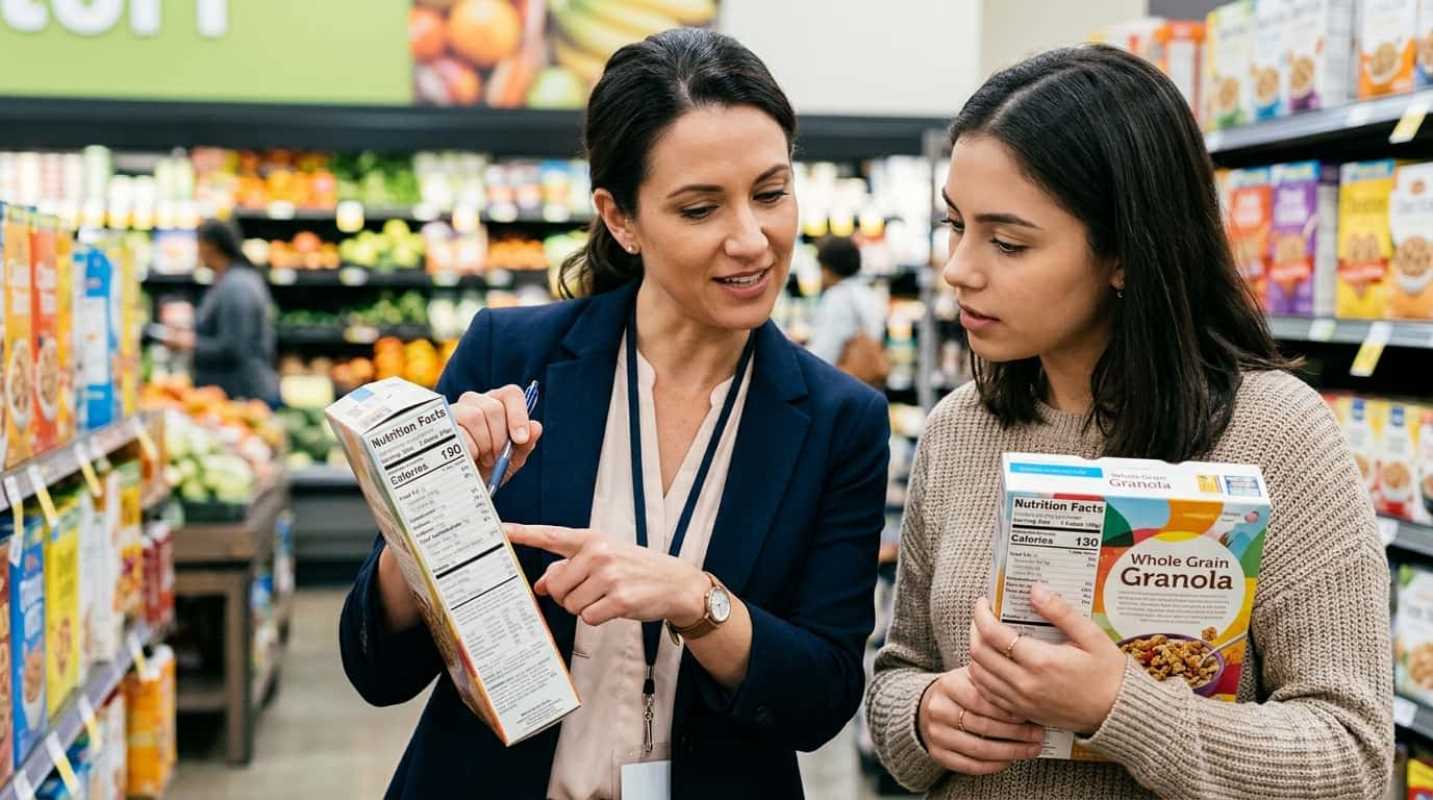
Have you ever stood in the grocery aisle staring at a box of cereal, completely paralyzed by the conflicting claims on the front? One side screams "all-natural," while the other boasts "high fiber." It is easy to feel like you need a biochemistry degree just to buy a loaf of bread. But here is a secret: health professionals do not look at the marketing buzzwords. They flip the box over.
The nutrition label is the most powerful tool in your grocery cart. It is your defense against clever advertising campaigns designed to make processed junk look like health food. Once you learn how to read these labels like a pro, the grocery store changes. You stop guessing and start decoding.
The Serving Size Trap: Why Context Matters
The very first thing a dietitian looks at is not the calorie count. It is the serving size.
Why? Because every single number on that panel is completely useless without context. If you ignore the serving size, you are playing right into the hands of food manufacturers. Think of it like checking your bank statement. If you see a charge for fifty dollars, you need to know if that is per month or per day before you decide if it is a good deal.
Food companies often use microscopic serving sizes to make high-calorie foods look light. A small bottle of tea might look like it only has seventy calories, but a closer look reveals the bottle contains three servings.
If you drink the whole bottle, you have to triple everything on that label. Suddenly, your seventy-calorie drink is actually a two hundred and ten calorie sugar bomb. Always compare the listed serving size to what you actually plan to eat. If the package says a serving of chips is twelve chips, but you know you will eat the whole bag, you need to do some quick math.
Health professionals call this contextual reading. It is the only way to protect yourself from accidentally overeating foods that claim to be light or low-calorie.
Mastering the Ingredient List: Spotting Hidden Sugars in Food
If the nutrition panel is the summary, the ingredient list is the true story. By law, ingredients must be listed in descending order by weight.
This means the first three ingredients make up the vast majority of what you are eating. If sugar, refined flour, or hydrogenated oil sits at the top of that list, put it back.
But food companies have gotten incredibly smart at hiding sugar. They use a sneaky tactic called sugar splitting.
Instead of listing thirty grams of cane sugar, which would force sugar to the very top of the list, they split it up. They might use ten grams of cane sugar, ten grams of maltodextrin, and ten grams of brown rice syrup.
Because these are weighed separately, they get pushed way down the list. This gives the product a false health halo, making you think it is low in sugar when it is actually packed with the sweet stuff.
In fact, researchers found that added sugar is hiding in seventy-four percent of all packaged foods sold in supermarkets.¹ It is not just in cookies either. It is in your marinara sauce, your salad dressing, and your favorite whole-wheat bread.
To spot these hidden sugars, you have to know their aliases. Sugar hides under more than sixty different names, but you can group them into a few key families:
• The ose family: ingredients like sucrose, fructose, dextrose, maltose, lactose, and galactose.
• The syrups: high-fructose corn syrup, brown rice syrup, maple syrup, carob syrup, malt syrup, sorghum syrup, and agave nectar.
• The natural pretenders: coconut sugar, date sugar, honey, molasses, turbinado sugar, cane juice, and fruit juice concentrates.
• Starch derivatives, maltodextrin, dextrin, ethyl maltol, barley malt, caramel, and invert sugar.
If you see three or four of these names scattered across a single list, that is a major red flag. It means the manufacturer is trying to keep sugar from appearing as the main ingredient.
Beyond the Calories: Navigating Macros and Micronutrients
Many people fall into the trap of looking only at calories. But a health professional focuses on nutrient density. Are those calories coming from fiber, protein, and healthy fats, or are they empty calories from refined carbs?
To quickly judge this, use the 5/20 rule. It is a simple shortcut for reading the Percent Daily Value (%DV) on the right side of the label.
• Five percent or less, this is low. You want this for things like sodium, saturated fat, and added sugars.
• Twenty percent or more, this is high. You want this for fiber, vitamins, calcium, and iron.
The average American eats about twenty-two teaspoons of added sugar every single day. That is roughly eighty-eight grams. Meanwhile, the American Heart Association recommends keeping it under six teaspoons for women and nine teaspoons for men.
Fortunately, the FDA has made it easier to spot these issues. They recently updated the rules for what can actually be labeled as healthy.
Under the new FDA rule, which went into effect on April 28, 2025, foods must meet strict limits on added sugars, sodium, and saturated fat to use the word on their packaging.²,³ Under the old rules, fat-rich but healthy foods like nuts, seeds, avocados, and salmon were banned from using the word healthy. Now, they qualify.³,⁴
The FDA is also pushing for a mandatory Front-of-Package nutrition label.⁵ This proposed rule would put a simple box on the front of packages labeling saturated fat, sodium, and added sugars as low, medium, or high.⁵
Although we wait for these changes to fully roll out by the 2028 compliance deadline, you still need to be your own advocate.
Here are some tools and resources to help you make better grocery choices.
The Professional's Checklist: A Quick Grocery Store Approach
You do not have twenty minutes to analyze every box in the supermarket. You need a fast, reliable routine.
Here is a simple three-step approach you can use to scan any label in under thirty seconds
1. Check the serving size: how many servings are actually in this package? Calculate the real numbers based on how much you plan to eat.
2. Apply the 5/20 rule to added sugars: check the %DV. If the added sugar is closer to twenty percent, put it back and look for an alternative.
3. Scan the first three ingredients: are they real, recognizable foods? Watch out for sugar splitting and avoid products with long lists of chemical additives.
Dietitian Erin Gager from Johns Hopkins Hospital points out that sugar is natural in many foods, like fruit. But she warns that you have to be savvy to spot the added stuff. Knowing where sugar hides helps you beat it at its own game.
By using this checklist, you can balance convenience with your health goals, even when you are in a rush.
Sources:
1. Artinci: Read Food Labels & Hidden Sugars
https://www.artinci.com/blogs/news/read-food-labels-hidden-sugars
2. Food Med Center: Updated FDA Guidelines
https://foodmedcenter.org/updated-fda-guidelines-for-2025-including-healthy-food-labeling-how-they-compare-to-the-2016-guidelines-and-what-it-could-mean-for-health-consumers-and-manufacturers/
3. FDA: Healthy Nutrient Content Claim
https://www.fda.gov/food/hfp-constituent-updates/fda-finalizes-updated-healthy-nutrient-content-claim
4. FDLI: FDA Final Rule Updates
https://www.fdli.org/2025/05/fda-final-rule-updates-the-healthy-nutrient-content-claim/
5. FDA: Front of Package Nutrition Labeling
https://www.fda.gov/food/nutrition-food-labeling-and-important-foods/front-package-nutrition-labeling
*This article on tikritus.com is for informational and educational purposes only. Readers are encouraged to consult qualified professionals and verify details with official sources before making decisions. This content does not constitute professional advice.*